

Scalping Strategy Explained: Profiting from Small Price Movements
Scalping Strategy Explained
Scalping strategy involves rapid trades to profit from small price movements. Learn how scalping works, key indicators, risk management, and whether it suits your trading style.
Introduction: The Fastest Trading Style
Scalping is the shortest-term trading strategy in the financial markets. Traders aim to profit from small price movements by entering and exiting positions rapidly, often holding trades for just seconds to a few minutes.
Instead of waiting for large price swings, scalpers attempt to capture many small gains that accumulate over time. It is one of the most intense and mentally demanding trading approaches.
Transaction Cost Visualizer
What Is Scalping?
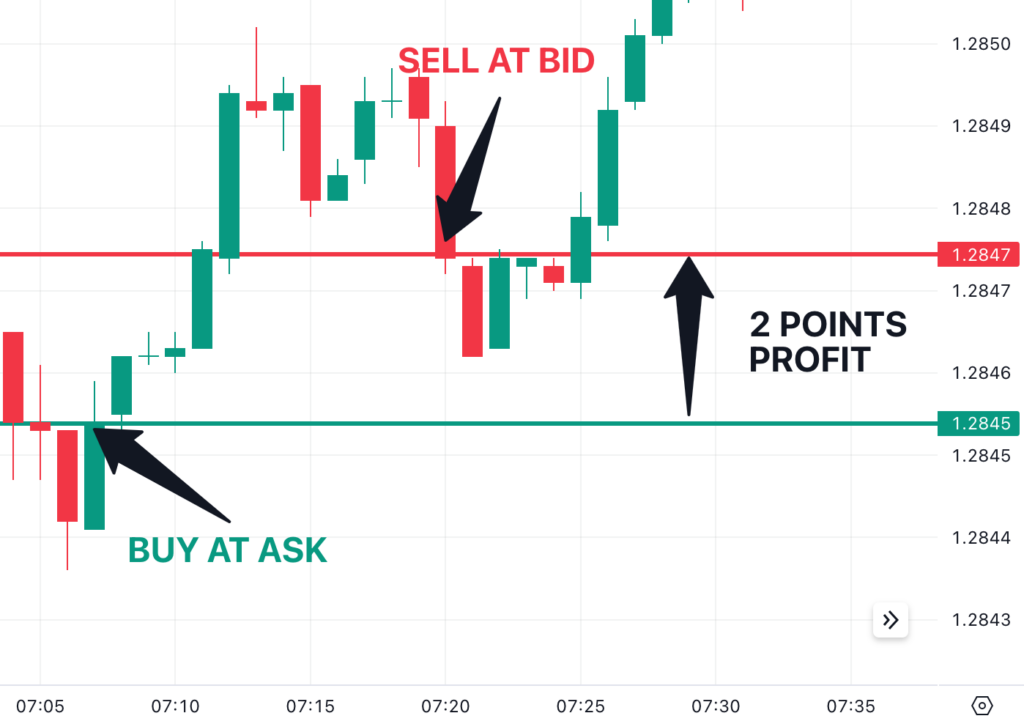
The strategy focuses on taking small profits quickly, capitalizing on micro price movements that occur in minutes. A scalper may execute dozens or even hundreds of transactions on an average trading day.
The principal aim is to achieve as many small profits as possible, rather than long-term trading strategies that aim for a small number of wins on a much larger scale. The theory is that small price changes are easier to predict than larger ones.
How Scalping Works
Traders watch for specific technical setups or patterns that suggest an immediate directional move, then act swiftly. A typical scalping sequence involves:
| Step | Action |
|---|---|
| 1 | Identify a currency pair approaching a support level on a one-minute chart |
| 2 | Enter a long position as price bounces |
| 3 | Set a tight profit target (e.g., 5–10 pips) |
| 4 | Exit within moments if the trade moves favourably |
| 5 | Cut the loss quickly if the market moves against the position |
Holding a position for 15 minutes would feel lengthy by scalping standards.
Scalping vs Day Trading vs Swing Trading
Understanding scalping is easier when comparing it to other approaches:
| Trading Style | Holding Period | Trades per Day | Screen Time Required |
|---|---|---|---|
| Scalping | Seconds to minutes | Dozens to hundreds | Constant |
| Day Trading | Minutes to hours | Several to dozens | High |
| Swing Trading | Days to weeks | Few per week | Moderate |
Day traders close all positions before the market closes but may hold trades for hours. Swing traders accept overnight risk, holding positions across multiple sessions to capture more substantial price swings.
Markets Commonly Used for Scalping
Certain markets suit scalping better due to liquidity and cost considerations:
| Market | Why It Works |
|---|---|
| Forex | Major pairs like EUR/USD, GBP/USD have tight spreads and high liquidity |
| Indices | FTSE 100, S&P 500, DAX offer sufficient volatility |
| Commodities | Gold and crude oil during news releases |
| Stocks | Highly liquid equities with significant daily volume |
The foreign exchange market is where traders find a vast majority of scalping opportunities because it has the highest trading volume and liquidity of all markets.
Common Scalping Techniques
Price Action Scalping
This relies purely on candlestick behavior without heavy indicators. Key tools include support and resistance, trendlines, and candlestick patterns. Common setups include breakout from consolidation, pullback to support, and rejection candles at resistance.
Moving Average Scalping
Moving averages help identify short-term trend direction. Common combinations include 9 EMA and 21 EMA, or 20 EMA and 50 EMA. Traders buy when price pulls back to EMA in an uptrend and sell when price pulls back to EMA in a downtrend.
VWAP Scalping
VWAP (Volume Weighted Average Price) is popular among professional scalpers. Price above VWAP indicates a bullish bias, while price below indicates bearish bias. Setups include buying near VWAP in an uptrend or selling near VWAP in a downtrend.
Breakout Scalping
This focuses on sudden price expansion at key levels such as pre-market highs/lows or range extremes. Traders enter only after volume confirmation and keep stop losses very tight.
Range Scalping
When the market moves sideways, scalpers trade inside a range. The approach involves buying near support and selling near resistance, exiting quickly at mid-range or opposite levels.
Key Scalping Indicators
| Indicator | Purpose |
|---|---|
| Bollinger Bands | Determine if price is high or low; assess volatility |
| Moving Averages (SMA/EMA) | Identify short-term trend direction |
| Stochastic Oscillator | Predict turning points in value |
| RSI | Signal overbought/oversold conditions on short timeframes |
The optimal timeframe for trading with Bollinger Bands is around 1 to 5 minutes. Moving averages are used in almost every strategy performed by trading professionals.

Risks and Challenges
Leverage Reality Check
With 50x leverage, a 2% adverse price movement will liquidate the entire position’s margin. Losses on each trade may be small, but they can soon mount up.
Transaction Cost Mathematics
A scalper aiming for five pips profit with a two-pip spread needs the market to move seven pips favourably just to achieve the target.
Risk Management Rules
| Rule | Guideline |
|---|---|
| Risk per trade | 0.25% to 1% of capital |
| Stop-loss | Always use a stop loss |
| Risk-reward ratio | Even 1:1 is acceptable |
| Max trades per session | No more than 6 |
Never average losses and maintain a favourable risk-reward. Because of high trade frequency, small losses can add up quickly if not controlled.
Suitability: Who Should Consider Scalping?
Scalping demands skills that typically develop through experience with less intensive trading approaches. Beginners face several disadvantages:
- Learning curve: Trading compresses decision-making into moments
- Capital erosion: Mistakes happen more often
- Cost burden: Smaller accounts face higher proportional transaction costs
The scalping approach may not be suitable for all traders, as it requires active monitoring of the market and can be mentally demanding.
Quick Takeaways
- Scalpers enter and exit positions as quickly as possible, making small but frequent profits
- The strategy is based on price action and doesn’t take into account fundamental factors
- Traders tend to prefer volatile markets where price fluctuations are more common
- Popular assets to scalp include stocks and forex, as these markets provide high liquidity
- Technical indicators such as moving averages and Bollinger Bands help traders spot price movements
- The approach may suit experienced traders better than beginners
Disclaimer: This article is for educational purposes only and does not constitute financial advice. Scalping involves high risk. Always consult a licensed financial advisor before making investment decisions

