
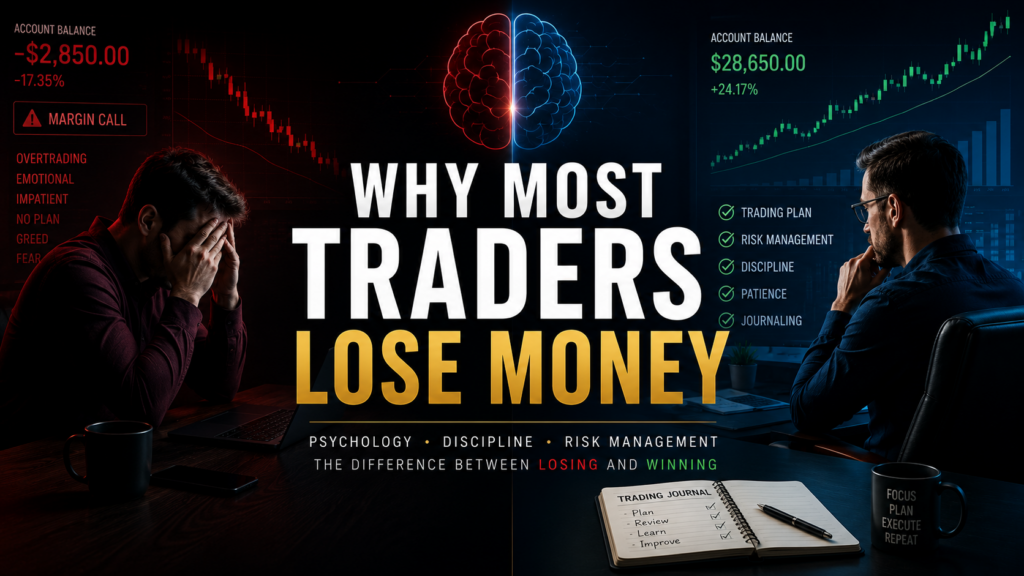
Why Most Traders Lose Money: 15 Common Mistakes and How to Avoid Them
Why Most Traders Lose Money
Every day, thousands of people enter the financial markets hoping to generate income through trading. Social media is filled with screenshots of massive profits, luxury lifestyles and promises of financial freedom.
Yet the reality is very different.
Most traders lose money.
Whether you’re trading forex, stocks, indices, commodities or cryptocurrencies, the majority of retail traders struggle to achieve consistent profitability. The good news is that understanding why traders fail can help you avoid the same mistakes and significantly improve your chances of success.
This guide explains the most common reasons traders lose money and what you can do differently.
Why Do Most Traders Lose Money?
Most traders don’t lose because the market is impossible to beat. They lose because they underestimate the skills, discipline and risk management required to succeed.
Successful trading is not about predicting the market perfectly. It’s about managing risk, controlling emotions and executing a proven strategy consistently over time.
1. Trading Without a Plan
One of the biggest mistakes traders make is entering the market without a clearly defined trading plan.
Many beginners open trades based on:
- Social media tips
- News headlines
- Emotions
- Fear of missing out (FOMO)
Without a plan, every trade becomes a gamble.
Solution
Create a trading plan that includes:
- Entry criteria
- Exit criteria
- Risk management rules
- Position sizing guidelines
- Trading goals
A professional trader follows a process. An amateur follows emotions.
2. Poor Risk Management
Many traders focus on profits while ignoring risk.
A single oversized trade can wipe out weeks or months of gains.
For example:
- Account Balance: R10,000
- Risk Per Trade: 20%
- Consecutive Losses: 5
The account loses more than half its value before the trader has a chance to recover.
Solution
Most experienced traders risk only 1% to 2% of their account on any single trade.
Protecting capital is the first rule of long-term trading success.
3. Letting Emotions Control Decisions
Fear and greed are responsible for countless trading losses.
Fear causes traders to:
- Close winning trades too early
- Avoid valid opportunities
- Hesitate when entering positions
Greed causes traders to:
- Hold losing trades
- Ignore risk management
- Overtrade
The market rewards discipline, not emotions.
4. Overtrading
Many traders believe more trades mean more profits.
In reality, excessive trading often leads to:
- Poor setups
- Increased commissions
- Emotional decision-making
- Burnout
Professional traders may take only a handful of high-quality trades each week.
Quality beats quantity.
5. Chasing Losses
After experiencing losses, many traders attempt to recover quickly by increasing position sizes.
This behavior is known as revenge trading.
It usually leads to:
- Larger losses
- Emotional decisions
- Account destruction
Solution
Accept losses as part of trading.
Every successful trader experiences losing trades.
The goal is not to avoid losses completely but to keep them small and manageable.
6. Unrealistic Expectations
Many beginners expect to double their accounts within weeks.
The reality is that professional traders focus on consistency rather than overnight riches.
A trader generating steady monthly returns over several years is often more successful than someone chasing huge gains.
7. Lack of Education
Many people start trading after watching a few YouTube videos.
Unfortunately, the market punishes ignorance.
Trading requires understanding:
- Market structure
- Technical analysis
- Risk management
- Trading psychology
- Fundamental analysis
Continuous learning is essential.
8. Ignoring Trading Psychology
Trading is largely a psychological game.
Many traders know how to analyze charts but struggle to manage their emotions.
Successful traders develop:
- Patience
- Discipline
- Emotional control
- Confidence in their strategy
Without these qualities, even the best strategy can fail.
9. Moving Stop Losses
A stop loss exists to limit risk.
However, many traders move their stop losses further away when a trade goes against them.
This often turns a small loss into a large one.
Rule
Never move a stop loss simply because you don’t want to accept being wrong.
10. Following Everyone Else
Social media has made trading information more accessible than ever.
Unfortunately, it has also created an environment filled with misinformation.
Many traders blindly copy:
- Signals
- Influencers
- Online groups
- Viral trading strategies
Successful traders develop their own process and understand why they are entering a trade.
11. Poor Position Sizing
Even a great strategy can fail if position sizes are too large.
Position sizing should be based on:
- Account size
- Risk tolerance
- Stop-loss distance
Proper position sizing protects traders during inevitable losing streaks.
12. FOMO Trading
Fear of Missing Out is one of the most expensive emotions in trading.
Traders often enter trades late because they see a strong move and fear being left behind.
This frequently results in buying near market tops or selling near bottoms.
Solution
Wait for your setup.
If the opportunity is gone, another one will come.
13. Lack of Patience
Many traders want immediate results.
However, successful trading often involves:
- Waiting for quality setups
- Following rules consistently
- Thinking long term
Patience is one of the most valuable skills a trader can develop.
14. No Trading Journal
Without a trading journal, traders repeat the same mistakes.
A journal helps track:
- Entry reasons
- Exit reasons
- Emotions
- Results
- Lessons learned
Professional traders review their performance regularly.
15. Treating Trading Like Gambling
Perhaps the biggest reason traders lose money is because they treat trading like gambling.
Gambling focuses on excitement.
Trading focuses on probability, discipline and risk management.
Successful traders think like business owners, not gamblers.
How Successful Traders Think Differently
Profitable traders understand that:
- Losses are normal
- Risk comes first
- Consistency beats excitement
- Discipline creates results
- Trading is a long-term journey
They focus on protecting capital rather than chasing profits.
Frequently Asked Questions
Why do most beginner traders lose money?
Most beginners lose money because they lack experience, proper risk management and emotional discipline. They often enter trades without a plan and take excessive risks.
Can trading be profitable?
Yes. Trading can be profitable when approached with proper education, risk management and a tested strategy. However, profitability usually requires significant time and practice.
What is the biggest mistake traders make?
Poor risk management is often considered the biggest mistake because it can quickly destroy a trading account regardless of strategy quality.
How much should I risk per trade?
Many professional traders risk between 1% and 2% of their account balance on a single trade.
Is trading psychology important?
Absolutely. Many experienced traders believe psychology is more important than strategy because emotions influence every trading decision.
Final Thoughts
The reason most traders lose money is not because the market is impossible to beat. It is because they fail to manage risk, control emotions and follow a structured process.
Trading success comes from consistency, discipline and continuous improvement.
Instead of focusing on how much money you can make, focus on becoming a better trader. When you master the process, profitability often follows.
The traders who survive and thrive are not necessarily the smartest. They are the ones who manage risk, learn from mistakes and stay disciplined when others allow emotions to take control.

