

How South African Traders Can Read US CPI Without Chasing the First Gold Move
Last updated: September 24, 2026
US inflation data can turn the gold market into one of the fastest-moving markets of the trading day.
When the US Consumer Price Index (CPI) is released, XAU/USD can move sharply within seconds. A stronger-than-expected inflation number can trigger a sudden sell-off in gold, while a softer reading can produce an equally aggressive move higher.
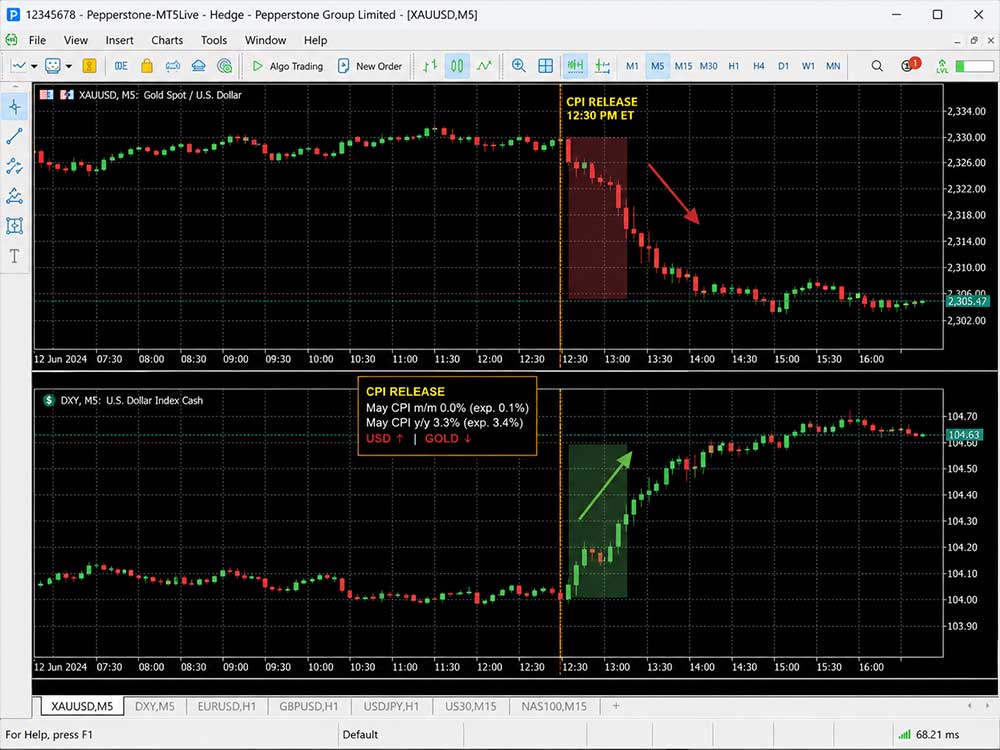
But the first move is not always the move traders should be trying to catch.
For South African traders, the more useful skill is learning how to read the CPI release in context, understand what the market expected, and then watch how the US dollar, Treasury yields and gold respond.
The objective isn’t to predict every CPI move. It is to understand the information arriving in the market and avoid entering simply because a large candle appeared on the chart.
What Is US CPI?
The US Consumer Price Index measures changes over time in the prices paid by consumers for a basket of goods and services.
The Bureau of Labor Statistics publishes the report each month, including headline CPI and a measure excluding food and energy, commonly referred to as core CPI. The CPI covers spending by urban consumers, representing more than 90% of the US population.
For traders, CPI matters because inflation influences expectations around US monetary policy.
If inflation appears to be persistent, markets may reassess expectations for interest rates. If inflation is slowing, markets may adjust expectations in the opposite direction.
Those changes can affect:
- US Treasury yields
- The US dollar
- Interest-rate expectations
- Risk sentiment
- Gold
- Other financial markets
That is why CPI should not be viewed as a single number that automatically tells you where gold is going.

Why the First Gold Move Can Be Misleading
Imagine CPI is released and gold immediately drops 30 or 50 points.
A trader sees the candle and thinks:
“Inflation is hotter, so gold is falling. I need to sell now.”
That can be dangerous.
The initial move may reflect algorithmic trading, stop-loss orders, positioning before the release, liquidity conditions and the market’s immediate interpretation of the headline.
Seconds or minutes later, traders may start analysing the details of the report.
Was the headline number actually the important part?
What happened to core inflation?
Which components caused the increase?
Did Treasury yields continue higher?
Did the US dollar confirm the move?
Did the market’s expectations for Federal Reserve policy actually change?
These questions can matter more than the size of the first candle.
Start With Expectations, Not Just the Actual Number
One of the most important concepts when trading economic data is the difference between the actual result and what the market expected.
Suppose traders are expecting monthly CPI to rise by 0.3%.
Three outcomes could look like this:
| Actual CPI | Initial interpretation |
|---|---|
| 0.2% | Cooler than expected |
| 0.3% | In line with expectations |
| 0.5% | Hotter than expected |
The same CPI number can also produce different market reactions depending on what traders had already priced in.
A number that looks high historically might still produce a limited reaction if it was already expected.
Likewise, a seemingly small deviation from expectations can produce a large move if the market was positioned heavily in one direction.
The surprise matters.
That is why traders should look at:
Actual → Forecast → Previous
before trying to interpret the release.
Headline CPI vs Core CPI
Headline CPI includes all of the major categories in the consumer basket.
Core CPI excludes food and energy.
That distinction matters because food and energy prices can be volatile.
The August 2026 report illustrates why looking beneath the headline can be useful. Headline CPI increased 0.4% month over month, while core CPI increased 0.3%. Over 12 months, headline CPI was up 3.4%, while core CPI was up 2.4%.
The details also showed that gasoline prices increased 3.9% during August and accounted for more than one-third of the monthly increase in the all-items index. Energy prices increased 2.1% during the month.
That tells traders something important:
Don’t stop at the headline.
A market reaction driven heavily by energy prices can have a different implication from an acceleration in a broad range of underlying prices.
Read the Components Behind the Number
After the headline and core figures, look at what actually moved.
Depending on the release, traders may pay attention to areas such as:
- Shelter
- Energy
- Food
- Transportation
- Medical care
- Used vehicles
- Services
- Goods
The purpose isn’t to become an economist during a live release.
The purpose is to determine whether the inflation surprise appears broad-based or concentrated in a particular category.
For example, if headline CPI rises sharply because of energy prices while core inflation remains relatively contained, the market may interpret the report differently from a situation where several underlying categories accelerate simultaneously.
This is why experienced traders often spend time reading the details after the initial reaction.
The Gold Connection: CPI → Rates → Yields → Dollar → Gold
There is no permanent one-to-one relationship between CPI and gold.
A more useful framework is:
CPI surprise → interest-rate expectations → Treasury yields and US dollar → gold
The Federal Reserve’s monetary-policy decisions are influenced by its dual mandate of maximum employment and price stability. In its September 2026 statement, the Federal Open Market Committee said inflation remained elevated and raised the federal funds target range by 25 basis points to 3.75%–4.00%.
That makes inflation data particularly relevant to markets.
A hotter CPI reading can cause traders to reassess expectations for monetary policy.
That reassessment can influence Treasury yields and the dollar.
Gold then responds to the changing market environment.
But this is not mechanical.
Gold can rise even when yields rise, or fall despite a softer inflation number, because multiple forces can be operating simultaneously.
That is why confirmation matters.
Watch US Treasury Yields
For gold traders, Treasury yields can provide valuable context after CPI.
If inflation comes in hotter than expected and Treasury yields rise sharply, that can reinforce the initial interpretation that markets are reassessing the outlook for interest rates.
If gold falls at the same time, the move has additional confirmation.
But what if CPI initially looks hot and gold falls, only for yields to reverse lower?
That creates a different situation.
The market may be reconsidering the initial interpretation.
The goal isn’t to predict which market will move first. It is to observe whether the major pieces of the market are telling a similar story.
Watch the US Dollar Too
The US dollar is another important part of the picture.
Gold is generally quoted in US dollars, so changes in the dollar can influence the price relationship.
After CPI, traders can watch instruments such as the US Dollar Index alongside XAU/USD.
A simple observation framework could be:
Hot CPI + rising yields + stronger dollar + falling gold
This represents a relatively coherent reaction.
But consider:
Hot CPI + rising gold + falling yields
That is a different market message.
Rather than forcing the trade, the trader can ask why the market is behaving differently from the expected relationship.
That question can be more valuable than immediately entering a position.
Don’t Confuse a Fast Move With Confirmation
A large candle creates urgency.
That urgency can lead to poor decisions.
Traders may enter after the move has already happened, place a stop in an obvious location, and then discover that the initial reaction reverses.
This is especially relevant around CPI because liquidity and volatility can change rapidly.
Instead of asking:
“How do I catch this move?”
ask:
“What is confirming this move?”
That small change in thinking can completely change how a trader approaches economic releases.
A Practical CPI Reading Process
South African traders can use a simple process when approaching a US CPI release.
1. Know the release time
US economic data is released according to US Eastern Time.
South African traders should convert the release time to South African Standard Time before the session begins.
Don’t rely on memory because daylight-saving changes in the United States can alter the time difference during the year.
2. Record the forecast
Before the release, know what economists and markets are expecting.
Look at:
- Headline monthly CPI
- Headline annual CPI
- Core monthly CPI
- Core annual CPI
3. Compare actual vs forecast
Once the report is released, compare the actual figures with expectations.
Don’t immediately trade.
4. Read the components
Determine what is driving the result.
Is the surprise coming from energy?
Shelter?
Services?
Goods?
Is core inflation moving in the same direction?
5. Watch yields
Look at the reaction in US Treasury yields.
Are yields confirming the inflation interpretation?
Or are they moving in the opposite direction?
6. Watch the dollar
Check whether the US dollar is confirming the broader reaction.
7. Return to gold
Only after looking at the wider market should you assess XAU/USD.
Look at:
- Direction
- Momentum
- Key support and resistance
- Candle structure
- Volume or liquidity conditions where available
- Whether the initial spike is holding
- Whether the move is being confirmed by yields and the dollar
8. Decide whether there is actually a trade
Sometimes the correct conclusion is that the market is too unclear.
Not every CPI release creates a clean setup.
Three CPI Scenarios Traders Can Think Through
Scenario 1: CPI Comes in Hotter Than Expected
Suppose inflation is significantly above expectations.
A possible market sequence could be:
Higher CPI → higher rate expectations → higher yields → stronger dollar → pressure on gold
But traders should still wait for the market to confirm that sequence.
If yields and the dollar don’t support the initial gold move, the setup becomes less straightforward.
Scenario 2: CPI Comes in Cooler Than Expected
A softer-than-expected inflation reading can cause markets to reassess expectations for monetary policy.
A possible sequence could be:
Lower CPI → lower rate expectations → lower yields → weaker dollar → support for gold
Again, this is a framework rather than a guaranteed outcome.
Other factors can dominate the market.
Scenario 3: CPI Is Mixed
This is where traders can become trapped.
For example, headline CPI might come in above expectations while core CPI is softer than expected.
Now the market has conflicting information.
Rather than forcing a bullish or bearish interpretation, traders can wait to see which component the broader market appears to be prioritising.
Mixed data can produce sharp two-way price action.
Why South African Traders Need Extra Discipline Around CPI
South African traders dealing in XAU/USD are exposed to the same global gold market as traders elsewhere, but their local trading environment has additional considerations.
The rand can also move against the US dollar.
This means South African traders should distinguish between:
Gold priced in US dollars
and
the effective local-currency value of gold.
A move in USD/ZAR can change the rand value of an international gold move.
This becomes particularly relevant for traders who think in rand while trading an instrument quoted in US dollars.
The underlying market remains global, but the trader’s account, risk and purchasing power may be affected by the USD/ZAR exchange rate.
The Biggest Mistake: Chasing the First Candle
The temptation is understandable.
CPI arrives.
Gold moves hundreds of points.
The trader feels that an opportunity is disappearing.
Then the trader enters.
Five minutes later, the market reverses.
This is one of the reasons news trading requires discipline.
The first move doesn’t have to be your move.
Waiting for confirmation can mean missing part of the move, but entering late without a defined setup can expose the trader to a reversal.
There is a trade-off between early entry and confirmation.
Every trader has to determine their own risk tolerance and methodology.
Don’t Trade the Number. Trade the Reaction.
This is the central idea behind reading CPI.
The economic release is information.
The market reaction is the second layer of information.
A trader can therefore think about CPI in three stages:
Stage 1: What did the report say?
Actual versus forecast.
Stage 2: What does the market think it means?
Watch yields, the dollar and rate expectations.
Stage 3: Is gold confirming the interpretation?
Look at XAU/USD price action.
This approach prevents a single CPI headline from becoming an automatic buy or sell signal.
CPI Trading Checklist
Before trading a US CPI release, ask:
- What is the market expecting?
- What was the previous reading?
- What is the actual headline CPI?
- What is the actual core CPI?
- Which components drove the surprise?
- Are Treasury yields moving higher or lower?
- Is the US dollar confirming the move?
- Is gold confirming the broader market reaction?
- Has the initial volatility settled?
- Where are the important technical levels?
- Where is the invalidation point?
- How much capital am I prepared to risk?
- Am I entering because I have a setup, or because I am afraid of missing the move?
That final question can be one of the most important.
Frequently Asked Questions
Does higher CPI always mean gold will fall?
No. A higher-than-expected CPI reading can influence expectations for interest rates, yields and the dollar, but gold does not respond mechanically to CPI. Market positioning, monetary-policy expectations, geopolitical developments and other factors can influence the reaction.
Why does gold move so quickly when CPI is released?
CPI is a major economic release watched by financial markets. New information can quickly change expectations around inflation and monetary policy, producing rapid repricing across currencies, bonds and commodities.
Should I buy or sell gold immediately after CPI?
There is no universal rule. The first price move can reverse. Traders can instead compare the CPI surprise with Treasury yields, the dollar and subsequent gold price action before deciding whether their trading setup is valid.
What is more important: headline CPI or core CPI?
Both provide useful information. Headline CPI includes food and energy, while core CPI excludes them. Looking at both, together with the components driving the change, provides more context than focusing on a single number.
How does CPI affect South African gold traders?
South African traders can be affected through the global XAU/USD market as well as movements in USD/ZAR. The rand-dollar exchange rate can therefore matter when considering the local-currency implications of international gold prices.
When is the next US CPI release?
The US Bureau of Labor Statistics has scheduled the September 2026 CPI release for October 14, 2026, at 8:30 a.m. Eastern Time. Traders should check the official release calendar because economic schedules can change.
Final Thoughts
US CPI is one of the most closely watched economic releases for traders, but it should not be treated as a simple “hot CPI = sell gold” or “cool CPI = buy gold” signal.
The better approach is to understand the surprise, investigate what caused it, and then watch how the broader market responds.
For gold traders, that means looking beyond the first XAU/USD candle.
CPI tells you what changed in inflation. Yields and the dollar can help show how markets are interpreting that change. Gold then provides another layer of price information.
The objective is not to catch every second of a CPI move.
It is to make decisions based on a process rather than the fear of missing a fast candle.
InvestInSA provides educational information and does not provide personalised investment or trading advice. Trading leveraged financial products involves significant risk, and losses can exceed expectations. Always consider your financial circumstances and risk tolerance before trading.

