

Petrol Costs More Than South Africa’s Hourly Minimum Wage
An alleged audio clip circulating on social media has brought South Africa’s rising cost of living and interest-rate outlook into focus. The clip attributes two striking statements to unnamed officials: that a litre of petrol costs more than an hour’s minimum wage, and that the South African Reserve Bank (SARB) will raise interest rates.
The claims have attracted attention against a difficult economic backdrop. Petrol prices increased sharply in October, while the Reserve Bank raised its benchmark interest rate in September in response to renewed inflation risks.
However, the authenticity of the alleged audio has not been independently verified, and the recording should not be treated as confirmation of another interest-rate increase. The SARB’s published policy statement provides a more reliable guide to its current position.
What Does the Alleged South African Audio Leak Claim?
The social media post attributes the following statements to two unidentified officials:
- Alleged government official: “A litre of petrol now costs more than the hourly minimum wage.”
- Alleged SARB official: “We will raise rates, don’t worry.”
The post frames the comments around the financial pressure facing South African households, particularly motorists and people already struggling with living costs.
At the time of writing, the identities of the alleged speakers, the original source of the recording and its authenticity have not been established by the information available for this report.
The alleged comments should therefore be understood as claims circulating online, rather than verified statements from the government or the South African Reserve Bank.
Petrol Prices in South Africa: How Much Does a Litre Cost?
South African motorists faced a significant fuel-price increase from 7 October 2026.
According to the South African government’s October fuel-price announcement, the price of 95-octane petrol increased by R3.33 per litre, while 93-octane petrol increased by R3.12 per litre.
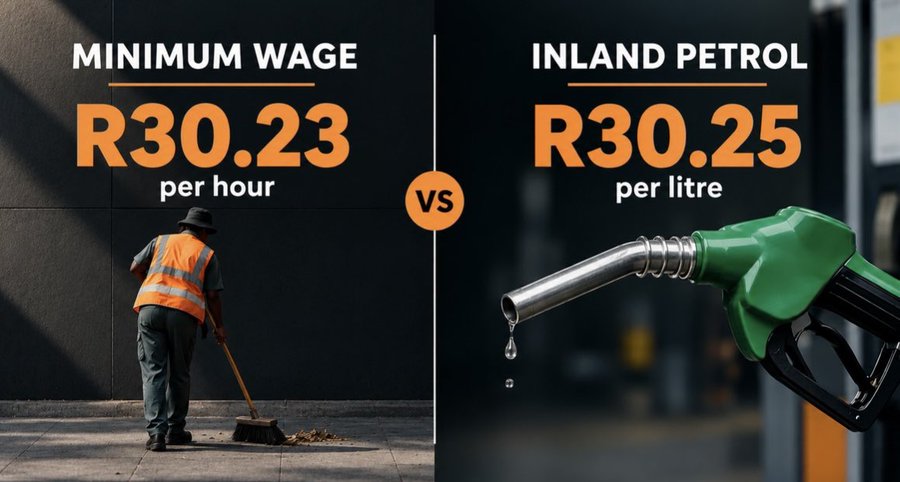
In Gauteng, 95-octane petrol reached R30.25 per litre, according to reporting by Mail & Guardian.
South Africa’s statutory national minimum wage increased to R30.23 per ordinary hour worked from 1 March 2026, according to the Department of Employment and Labour.
The comparison made in the viral post is therefore broadly consistent with those figures for Gauteng’s 95-octane petrol: a litre costs two cents more than the national minimum wage for one ordinary working hour.
That comparison does not mean petrol costs more than an hour’s wages for every worker. Actual earnings vary, and fuel prices differ by grade and pricing zone. Nevertheless, it illustrates the pressure that a sharp fuel-price increase can place on household budgets.
Why did petrol prices rise in October?
The government attributed October’s fuel-price adjustments to a combination of international and domestic factors. These included higher Brent crude oil prices, geopolitical uncertainty affecting oil supplies, increased shipping costs and changes in international petroleum-product prices.
South Africa imports crude oil and finished petroleum products, making local fuel prices sensitive to global energy markets and the rand-dollar exchange rate.
When fuel becomes more expensive, the impact can extend beyond motorists. Businesses that depend on transport may face higher operating costs, potentially putting pressure on the prices of goods and services.
Did the South African Reserve Bank Say It Will Raise Interest Rates Again?
There is no verified basis in the alleged recording alone to conclude that the SARB has committed to another rate increase.
The central bank’s most recent published monetary policy decision, announced on 23 September 2026, raised the repo rate by 25 basis points to 7.25%, effective 25 September. The decision was unanimous.
The increase came as the Bank highlighted renewed inflation risks, including higher global energy prices and elevated inflation expectations.
In its September 2026 Monetary Policy Committee statement, the SARB said its policy-rate projection showed the rate broadly stable through the remainder of 2026, with cuts later in the forecast period as inflation moved towards the Bank’s target.
Crucially, the Bank described that projection as a broad policy guide. It said future decisions would be taken meeting by meeting, with consideration given to incoming data and the balance of risks.
This means that further increases cannot be ruled out, but neither can they be treated as certain based on the viral quote.
The SARB’s next scheduled monetary policy decision is 19 November 2026.
How Higher Petrol Prices Could Affect Inflation and Interest Rates
Fuel prices matter to monetary policy because they can influence inflation directly and indirectly.
When petrol prices rise, motorists pay more to fill their tanks. Businesses may also face higher costs for transporting products, delivering services and operating vehicles. If those costs are passed on to customers, inflationary pressure can spread through the economy.
The SARB must assess whether a fuel-price shock is temporary or likely to contribute to broader, persistent price increases.
A one-off increase in petrol prices does not automatically require another rate hike. However, if inflation expectations rise, or if higher fuel costs feed into wider prices and wages, the Bank may consider a tighter policy stance necessary to protect price stability.
Interest rates are only one part of the picture. Global oil prices, exchange-rate movements, food prices, economic growth and household spending also influence the inflation outlook.
What Does the Repo Rate of 7.25% Mean for South Africans?
The repo rate influences the interest rates commercial banks charge borrowers and offer savers. Changes in the policy rate can therefore affect home loans, vehicle finance, personal loans, credit facilities and savings products.
Following the September decision, the prime lending rate rose to 10.75%, according to reporting by BusinessTech.
For households with variable-rate debt, a higher interest rate can increase monthly repayments and leave less disposable income for food, transport and other essentials. Businesses may also face more expensive financing, potentially affecting investment and expansion plans.
Higher rates can, however, help moderate demand and limit persistent inflation. They can also improve the returns available on some interest-bearing savings products, although the benefit depends on the product and its terms.
The overall effect is not identical for every household. People with substantial debt may feel rate increases more directly, while savers may benefit from higher interest income.
What Should Investors and Forex Traders Watch?
The combination of higher fuel costs and an uncertain interest-rate outlook has implications for South African markets.
The rand: Changes in global risk sentiment, commodity prices, capital flows and expectations for interest rates can influence the rand. A stronger or weaker rand also affects the local cost of imported fuel.
Inflation data: South Africa’s latest consumer inflation figures and subsequent releases will help investors assess whether fuel costs are contributing to broader price pressure.
SARB communication: The Bank’s statements and Governor Lesetja Kganyago’s public comments offer a more reliable guide to policy than an unauthenticated social media recording.
Bond yields and interest-rate expectations: Investors monitor government bond yields and market pricing for clues about expected inflation and future monetary policy. These indicators can change as new information emerges.
Global oil prices: Further disruption to oil supplies or a sustained increase in crude prices could add to local inflation risks, particularly if the rand weakens at the same time.
For forex traders, these factors may affect the rand and currency pairs involving the South African currency. However, no single headline guarantees a particular market reaction.
Could the SARB Raise Interest Rates Again in 2026?
A further rate increase remains a possibility if inflation risks intensify, but the available evidence does not establish that another hike is inevitable.
The SARB’s September policy statement projected the repo rate to remain broadly stable for the rest of 2026 under its baseline outlook. It also emphasised that this was not a binding promise and that decisions would depend on new data and changing economic conditions.
The distinction matters. A forecast is not a commitment, and a statement attributed to an unidentified speaker in an unverified audio clip is not an official policy announcement.
Investors and consumers should watch upcoming inflation data and the Bank’s November meeting for clearer signals about the direction of monetary policy.
The Bottom Line
South Africa’s October petrol-price increase has intensified the cost-of-living debate. In Gauteng, 95-octane petrol reached R30.25 per litre, slightly above the national minimum wage of R30.23 per hour. Meanwhile, the SARB’s repo rate stands at 7.25% following its September increase.
These are verified economic developments. The alleged audio, by contrast, has not been independently authenticated, and the claim that the Reserve Bank will raise rates again should not be presented as established fact.
For households, businesses and investors, the key question is whether higher fuel costs translate into more persistent inflation. The SARB’s published statements and incoming economic data will provide a firmer basis for assessing that risk than the viral recording.
This article is for informational and educational purposes only and does not constitute financial or investment advice.
Frequently Asked Questions
Is the alleged South African government audio leak real?
Its authenticity has not been independently verified in the information available for this report. The identities of the alleged speakers and the original source of the recording have not been established.
How much does petrol cost in South Africa in October 2026?
From 7 October, 95-octane petrol increased by R3.33 per litre and 93-octane petrol increased by R3.12. In Gauteng, 95-octane petrol reached R30.25 per litre. Prices vary by fuel grade and pricing zone.
What is South Africa’s national minimum wage in 2026?
The statutory national minimum wage is R30.23 per ordinary hour worked, effective from 1 March 2026, subject to the applicable legal provisions and exemptions.
What is the South African Reserve Bank’s repo rate?
The SARB raised its policy rate by 25 basis points to 7.25% in September 2026. The prime lending rate subsequently stood at 10.75%.
Will the SARB raise interest rates again in November 2026?
No further increase has been confirmed. The next scheduled policy decision is on 19 November 2026. The outcome will depend on the inflation outlook, incoming economic data and the Monetary Policy Committee’s assessment.
Why do higher petrol prices matter for interest rates?
Higher fuel costs can raise household transport expenses and business operating costs. If the effects spread into broader inflation or raise inflation expectations, the SARB may consider a tighter policy stance. A fuel-price increase alone does not guarantee a rate hike.
Where can I check official South African interest-rate announcements?
The South African Reserve Bank’s official website publishes Monetary Policy Committee statements, policy-rate information and other central-bank communications.

