
Broker Deposit Quirks & Regulatory Nuances: A Guide to the Fine Print
Discover the hidden deposit quirks and regulatory nuances of top brokers like AvaTrade. From country-specific minimums to crypto funding options, know what to expect before you trade.
Beyond the Headline Numbers
When choosing a broker, the advertised minimum deposit is often just the beginning of the story. Beneath the surface lie regional differences, payment method quirks, and regulatory structures that can significantly impact your trading experience. Understanding these nuances is key to selecting a broker that truly fits your needs.
This guide breaks down the unique deposit quirks and regulatory structures of a top global broker, AvaTrade, and provides a framework for evaluating others.
1. The Regional Deposit Quirk: Not All Minimums Are Equal
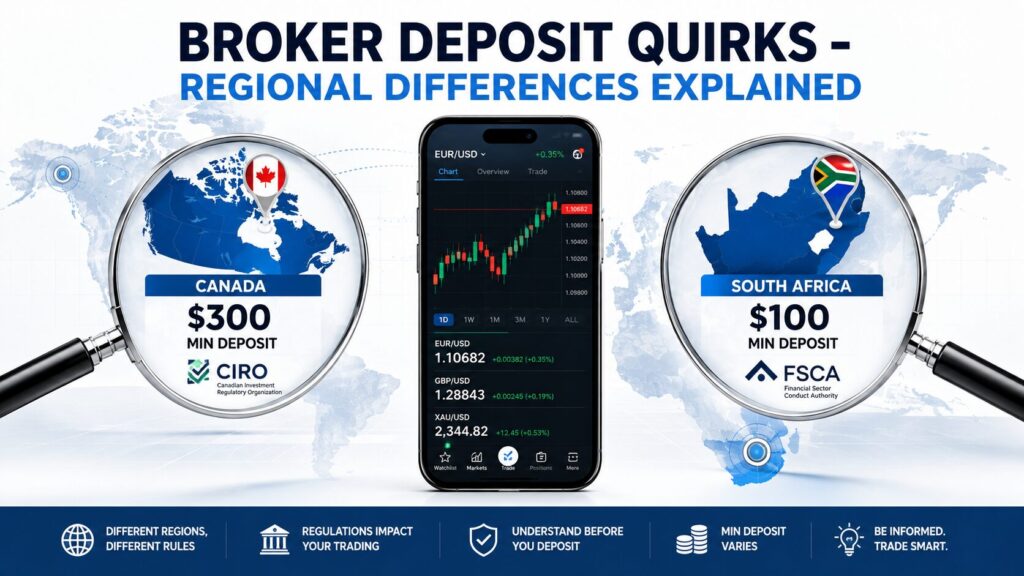
A broker’s minimum deposit can change based on where you live and the currency of your account. This is not a hidden rule, but rather a reflection of differing regional regulations, local currencies, and operational costs. A clear example of this is AvaTrade’s deposit requirements for South African vs. Canadian traders.
AvaTrade South Africa
For South African clients, AvaTrade offers a very accessible entry point:
- Retail Account Minimum: $100 (approx. R1,800) .
- Islamic Account Minimum: The same accessible $100 applies .
- Payment Methods: Supports South African rand (ZAR) deposits and a variety of international methods including bank transfer, credit/debit cards, and e-wallets like Neteller and Skrill .
AvaTrade Canada
The minimum deposit for Canadian residents is notably higher:
- Minimum Deposit: CAD $300 or USD $250 .
- Local Regulation: This higher minimum reflects the fact that Canadian accounts are held with Friedberg Direct, a regulated Canadian investment firm, ensuring compliance with local regulatory standards .
This comparison shows the importance of checking the minimum deposit for your specific region, not just the global advertised amount.
2. Payment Method Nuances: More Than Just a Minimum
The method you choose to fund your account can come with its own set of rules and quirks. While the overall account minimum might be $100, the minimum for a specific payment method could be different. The availability of certain methods is also highly regional .
Crypto as a Trading Asset, Not a Deposit Method
While digital assets are becoming more common in the financial world, it is important to distinguish between crypto trading and crypto funding. AvaTrade does offer cryptocurrency trading (as CFDs) on its platforms , but it does not accept direct deposits via Bitcoin, USDT, or other cryptocurrencies.
AvaTrade’s official funding methods are limited to traditional and electronic payment systems:
Important distinction: You can trade crypto CFDs, but you must fund your account using fiat currency (USD, EUR, ZAR, etc.) or an accepted e-wallet. If a source claims AvaTrade accepts Bitcoin deposits, it is likely referring to crypto trading or a different broker .
Regional Payment Method Limitations
Not every payment method is available to every trader. The options you see will depend heavily on where you are located and the specific regulations of that region . For example:
| Region | Key Payment Method Limitation |
|---|---|
| South Africa | ZAR bank transfers recommended; card payments may be blocked by local banks unless pre-approved . |
| Canada | Minimum deposit is higher (CAD 300 or USD 250); crypto trading is not available on this entity . |
| Global | Electronic payment methods like Skrill and Neteller are not available to clients in the EU and Australia . |
| Payment Method | AvaTrade Availability | Minimum Deposit |
|---|---|---|
| Bank Transfer | Global | $100 – $500+* |
| Credit/Debit Card | Global | $100 |
| Neteller | Most regions (exceptions apply) | $100 |
| Bitcoin | ||
| Skrill | Most regions (exceptions apply) | Varies |
Example: European clients might find a wider range of payment methods like Skrill and Neteller readily available compared to traders in other regions, where options might be more limited .
3. Regulatory Nuances: Who is Your Account Actually With?
Understanding the legal entity that holds your funds is crucial for understanding your protections as an investor. A broker’s “global license” doesn’t always tell the full story.
The White-Label Structure: The Canadian Example
In some cases, a global broker partners with a local regulated firm to offer its services in a specific country.
- How it Works: AvaTrade, the global brand, powers the platform, but Canadian accounts are held by Friedberg Direct, a division of the Friedberg Mercantile Group Ltd .
- What it Means for You:
- Your account is regulated by the Canadian Investment Regulatory Organization (CIRO) .
- Your funds are protected by the Canadian Investor Protection Fund (CIPF) within specified limits .
- This structure provides the familiarity and security of local regulation while offering access to AvaTrade’s technology .
Quick Reference Table
| Nuance | AvaTrade (South Africa) | AvaTrade (Canada) |
|---|---|---|
| Minimum Deposit | $100 USD (~R1,800) | $300 CAD / $250 USD |
| Regulator | FSCA | CIRO, CIPF (via Friedberg Direct) |
| Local Entity | AvaTrade (Global) | Friedberg Direct |
| Crypto Funding | Yes (e.g., Bitcoin) | Check availability |
Frequently Asked Questions
Why does the minimum deposit vary by region?
It is often determined by local regulations, the currency of the account, and the operational costs of the specific regional office .
Are there fees for depositing via e-wallets?
Many brokers, including AvaTrade, do not charge internal fees for deposits via Neteller or Skrill, but you should check the terms of your payment provider .
Does AvaTrade accept crypto deposits in South Africa?
Yes, it is among the available options, with minimum deposits starting from $100 .
What is the difference between AvaTrade and Friedberg Direct?
Friedberg Direct is a Canadian investment firm that partners with AvaTrade to offer its platform and technology to residents of Canada, ensuring local regulation and investor protection .
Is my money safe with a regulated broker?
When you trade with a broker regulated by a reputable body like the FSCA or CIRO, your funds are generally required to be held in segregated accounts, offering a key layer of protection .
Disclaimer: This article is for informational purposes only and does not constitute financial advice. Trading involves risk. All information is subject to change. Always check the broker’s official website for the most current deposit methods, fees, and regulatory information for your specific region.

