

Brent Crude Falls After Nearing $110: What Happens Next?
Updated: 11 September 2026
Brent crude oil is pulling back sharply after briefly approaching $110 a barrel, giving the oil market some relief after a powerful rally driven by escalating Middle East supply concerns.
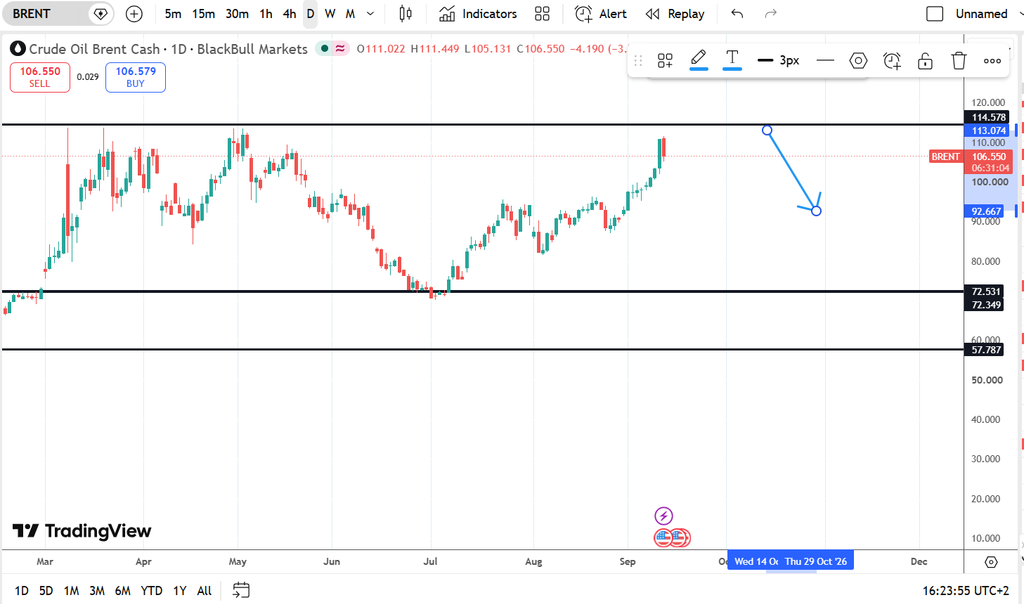
Brent crude futures were recently around $104.35 a barrel, down 3.05% on the day, while WTI crude was around $99.07, down 3.33%. Despite the decline, Brent remained on track for a weekly gain of more than 8%.
The immediate question for traders and investors is whether this is simply a short-term correction after a major rally or the beginning of a deeper decline in oil prices.
For South Africa, the answer matters because Brent crude, refined petroleum prices and the rand all feed into the country’s fuel-price outlook.
Key Takeaway
Brent crude has pulled back after nearing $110, but the oil market is still facing significant supply risks.
The decline followed reports of possible diplomatic efforts involving Iran and Gulf countries aimed at managing shipping through the Strait of Hormuz. That eased some immediate fears over supply disruptions and prompted traders to take profits after Thursday’s sharp rally.
However, the situation remains highly volatile.
Brent surged more than 6% on Thursday to settle at $107.63, its highest level since May, after attacks on shipping and energy infrastructure intensified.
That means today’s decline should not automatically be interpreted as the end of the oil rally.
Why Is Brent Crude Falling Today?
The biggest immediate reason is a reduction in some of the market’s worst-case supply fears.
Reports indicated that Middle Eastern foreign ministers were exploring a temporary arrangement with Iran concerning shipping through the Strait of Hormuz.
That matters because Hormuz is one of the world’s most important energy corridors.
Any development that could improve shipping through the strait can reduce the immediate risk premium that traders have placed on crude oil.
Reuters reported that Brent reversed earlier gains after reports of possible diplomatic efforts to manage shipping through Hormuz.
There is also a profit-taking element.
After Brent jumped more than 6% on Thursday, traders had a reason to lock in gains when the market opened lower.
In other words:
$100+ oil rally → traders take profits → geopolitical risk premium eases → Brent pulls back.
Brent Crude Nearly Reached $110
The latest move is easier to understand when looking at the sequence of events.
On Thursday, Brent surged more than 6% and settled at $107.63 a barrel. It had already moved above $100 as fears over tanker attacks and supply disruptions intensified.
Brent subsequently moved closer to the $110 level before reversing lower on Friday.
That creates an important technical and psychological level for traders.
$100 Brent
The $100 level is psychologically important because crude had spent much of the year below it before the recent escalation in geopolitical risk.
$108–$110
This area has now become an important short-term resistance zone after the latest surge.
Below $105
A sustained move below the recent highs could signal that some of the geopolitical risk premium is coming out of crude.
But one daily decline is not enough to confirm a lasting reversal.
Is This the Start of a Bigger Oil Price Drop?
It could be, but it is too early to say.
The oil market remains heavily dependent on developments in the Middle East.
The current pullback is occurring against a backdrop of serious supply disruptions.
Reuters reported that Saudi Arabia’s crude supply fell by 2.3 million barrels per day in August to 6 million barrels per day, its lowest level in more than three decades, according to the International Energy Agency.
Shipping through the Strait of Hormuz has also been disrupted, while risks have expanded to the Bab el-Mandeb shipping route.
That means the market still has significant upside risk if the geopolitical situation deteriorates again.
As UBS energy analyst Giovanni Staunovo told Reuters, near-term risks remain tilted to the upside, although oil-price volatility is expected to remain high.
What Could Push Brent Lower?
There are several factors that could send oil prices lower from current levels.
1. A diplomatic breakthrough
If negotiations produce a credible arrangement that allows shipping through the Strait of Hormuz to normalise, the geopolitical premium in oil could fall.
That would potentially remove one of the biggest reasons traders have been bidding crude higher.
2. Improved oil supply
If disrupted production and exports begin returning to the market, the supply shortage could ease.
3. Weaker global demand
Higher energy prices can eventually hurt economic activity.
The International Energy Agency has warned of a major deterioration in global oil-demand conditions amid the current energy disruption, while also highlighting the severe supply shock facing the market.
4. A stronger US dollar
Oil is priced in US dollars.
A stronger dollar can make crude more expensive for buyers using other currencies and can add pressure to demand.
5. Profit-taking
After such a rapid rally, traders may continue locking in gains.
That could create additional short-term downward pressure even without a major change in the underlying fundamentals.
What Could Push Brent Back Above $110?
The downside is not guaranteed.
There are several risks that could quickly send oil higher again.
Escalating attacks
Further attacks on tankers, pipelines, ports or energy infrastructure could increase supply fears.
Hormuz remains disrupted
If shipping through the Strait of Hormuz remains severely restricted, traders could continue pricing a substantial supply risk into crude.
Lower Saudi exports
Reduced Saudi supply would add to the pressure on an already disrupted market.
Wider regional conflict
If the conflict spreads to additional oil-producing countries or shipping routes, the market could quickly add another layer of risk premium.
Refined-product shortages
Crude oil is only part of the problem.
Diesel and jet-fuel markets are also experiencing significant pressure.
Reuters reported that US diesel prices moved above $6 a gallon, highlighting how supply disruptions can affect refined products even when crude prices pull back.
What Does Today’s US CPI Data Mean for Oil?
The United States released its August inflation data on Friday.
US consumer prices increased 0.4% month-on-month in August, while annual CPI remained at 3.4%. Core CPI increased 0.3% month-on-month and 2.4% year-on-year.
The headline CPI result was broadly in line with expectations, while core inflation was slightly stronger than economists had forecast.
Market expectations for a Federal Reserve rate hike at next week’s meeting subsequently increased, with Reuters reporting that the implied probability rose to around 82%, from 68% before the release.
For oil, the relationship is complicated.
Higher interest rates can put pressure on economic growth and therefore energy demand.
But oil is currently being driven heavily by physical supply and geopolitical risks, meaning the Federal Reserve is not the only factor determining Brent’s direction.
The important distinction is:
CPI influences the macroeconomic outlook.
Middle East supply disruptions influence the immediate oil-market risk premium.
Today’s Brent pullback appears to have been driven more directly by changing geopolitical and shipping expectations than by the CPI release itself.
What Does Falling Brent Mean for South Africa?
A lower Brent price can be positive for South African motorists because international petroleum prices are an important component of the country’s fuel-price calculation.
But South Africans should not look at Brent alone.
The rand-dollar exchange rate is equally important.
If Brent falls while the rand strengthens, South Africa could receive a larger benefit.
If Brent falls while the rand weakens significantly, the currency could offset part of the benefit.
The relationship can be simplified:
Brent ↓ + Rand ↑ = Stronger downward pressure on fuel prices
Brent ↓ + Rand ↓ = Mixed impact
Brent ↑ + Rand ↓ = Strong upward pressure
This is why the USD/ZAR exchange rate should be monitored alongside Brent when assessing the South African fuel-price outlook.
Could Lower Oil Prices Reduce South African Inflation?
Potentially, yes.
Fuel affects the South African economy far beyond motorists.
Lower petrol and diesel costs can reduce expenses for:
- Transport companies
- Logistics businesses
- Agriculture
- Manufacturers
- Retailers
- Construction companies
- Delivery businesses
If those savings are passed through to consumers, lower fuel prices can help reduce broader inflationary pressure.
The opposite is also true.
A renewed oil-price surge could increase transportation and operating costs across the economy.
Brent Crude Price Outlook: What Happens Next?
The immediate outlook is likely to remain highly volatile.
The key question is whether today’s decline develops into a sustained correction.
Bullish oil scenario
If attacks continue, shipping remains restricted and supply disruptions worsen, Brent could retest the recent highs around $108–$110 and potentially push higher.
Neutral scenario
If geopolitical tensions remain elevated but do not deteriorate further, Brent could remain highly volatile around the $100–$110 range.
Bearish oil scenario
If diplomatic efforts make meaningful progress, shipping through major routes improves and supply fears ease, the risk premium could unwind and Brent could move materially lower.
The market is therefore watching geopolitical developments as closely as traditional supply-and-demand data.
Brent Crude: Key Levels to Watch
For traders watching the current move, several levels stand out.
$110: Major psychological and recent resistance area.
$108: Recent post-rally zone and important short-term reference.
$105: Important area around today’s trading range.
$100: Major psychological level and potential support.
A sustained break below $100 would represent a much bigger change in the current market structure than today’s pullback.
However, traders should avoid treating individual price levels as guaranteed support or resistance.
Oil can move violently when geopolitical headlines change.
Is Brent Crude Still Bullish?
On the weekly timeframe, the picture remains elevated despite today’s decline.
Reuters reported that Brent remained on course for a weekly gain of more than 8% even after falling more than 3% on Friday.
That is important.
A market can fall sharply on a single day while still being strongly higher over the week.
Therefore, today’s move should currently be viewed as a pullback within a highly volatile market, rather than automatically calling it a confirmed bearish reversal.
The next major test will be whether Brent can stabilise below the recent highs or whether renewed geopolitical risk sends it back toward $110.
What Brent Crude Means for Petrol Prices
For South African consumers, the oil-price move is particularly important.
If Brent remains below its recent highs, it could reduce some of the pressure coming from international energy prices.
But the rand remains critical.
A weaker rand could offset part of the benefit of cheaper crude, while a stronger rand could amplify it.
That makes the following combination particularly important:
Brent crude + USD/ZAR + international refined fuel prices.
Together, these provide a much better indication of where South African fuel-price pressure could be heading.
What Happens Next for Brent Crude?
The next major move in Brent will probably depend on whether the market gets real evidence of improving supply conditions.
If diplomatic efforts around shipping routes progress, oil could continue giving back part of its recent geopolitical premium.
If attacks intensify or shipping disruptions worsen, traders could quickly return to the bullish side of the market.
For now, Brent’s move from near $110 to around $104 is significant, but it is not enough on its own to confirm that the oil rally is over.
The bigger question is whether the market can move back below $100 and stay there.
Until that happens, the oil market remains vulnerable to another sharp move higher.
Frequently Asked Questions
Why is Brent crude falling today?
Brent crude is falling after approaching $110 as reports of possible diplomatic efforts around shipping through the Strait of Hormuz eased some immediate supply concerns. Profit-taking after Thursday’s sharp rally is also contributing to the pullback.
How high did Brent crude rise?
Brent settled at $107.63 on Thursday after rising more than 6%, and subsequently traded close to the $110 level before pulling back.
Is Brent crude heading below $100?
It is possible, but there is no confirmation yet. A sustained decline in geopolitical risk and improving supply conditions could push Brent lower, while renewed disruptions could send it back toward $110.
Why is oil above $100?
The current surge has been driven largely by fears of prolonged supply disruptions connected to the conflict in the Middle East, including disruptions around the Strait of Hormuz and Bab el-Mandeb.
What does lower Brent crude mean for South Africa?
Lower Brent can reduce pressure on South African fuel prices, but the benefit depends partly on the rand. A weaker rand can offset some of the benefit of cheaper oil.
Will lower oil prices make petrol cheaper in South Africa?
They can contribute to lower fuel prices, but petrol prices also depend on the rand-dollar exchange rate, international refined-product prices and other components of South Africa’s fuel-price calculation.
Bottom Line
Brent crude has pulled back sharply after nearing $110, but the oil rally is not necessarily over.
The decline to around $104 has followed a major weekly surge and comes as traders react to possible diplomatic efforts around the Strait of Hormuz.
For investors, the key question is whether this is the beginning of a deeper correction or simply a pause in a market still dominated by geopolitical supply risks.
For South Africa, Brent is only half of the equation.
Watch Brent crude and USD/ZAR together.
If oil falls and the rand strengthens, South African motorists could get meaningful relief.
If oil falls but the rand weakens, the benefit could be much smaller.
And if geopolitical tensions send Brent back toward $110 while the rand remains under pressure, the outlook for South African fuel prices could become considerably more difficult.
Trade Brent Crude With AvaTrade
If you want to trade movements in Brent crude rather than simply follow the oil market, AvaTrade offers access to oil trading through CFDs.
Brent crude can be particularly interesting during periods of elevated volatility because geopolitical developments, supply disruptions, US economic data and changes in the US dollar can produce large moves in oil prices.
You can use the link below to explore AvaTrade’s oil-trading offering and see the current trading conditions available to you:
Trade Brent Crude With AvaTrade
Why Trade Brent Crude?
Brent crude is one of the most widely followed global oil benchmarks. Traders can take positions based on their view of whether oil prices could rise or fall.
The current market is a good example of why crude oil can move quickly. Brent recently approached $110 a barrel before pulling back, with geopolitical developments around global shipping and energy supplies playing a major role.
However, oil CFDs are high-risk leveraged products. A relatively small move in Brent can have a much larger effect on a leveraged trading position.
Before opening a position, traders should understand:
- How oil CFDs work
- The costs involved in trading
- Margin requirements
- The effect of leverage
- Overnight financing charges
- Stop-loss and risk-management techniques
- The potential for losses exceeding expectations
Affiliate disclosure: InvestInSA may earn a commission if you register or trade through the AvaTrade link above. This does not affect the editorial analysis or the information presented in this article.
Risk warning: CFDs are complex instruments and come with a high risk of losing money rapidly due to leverage. Make sure you understand how CFDs work and whether you can afford to take the risk before trading.
CTA
Want to trade the Brent crude price?
Explore Brent crude trading with AvaTrade
I’d put this after the “What Does Brent Crude Mean for Petrol Prices?” section and before the FAQs, so the article first establishes authority and search value, then introduces the affiliate offer naturally.

